Author Archives: Emrys

How to hang a Rising Gate

Much to my surprise, I found that the best way to hang a rising gate is not common knowledge. In fact, I’ve found it nowhere, and I had to work it out from scratch when I first needed to use the technique.

To make a rising gate, one hinge needs to be offset. The hinges aren’t one above the other.

When the gate is closed, the uprights of the gate need to be vertical, and the top bar of the gate needs to be vertical.

When the gate is open, the top bar of the gate needs to be rising up at an angle. That’s what we want, that’s why it’s called a rising gate.

But, when the gate is open, it’s very nice if the gate is still upright, and is not skewed off at some odd angle. That looks much neater when the gate is hooked back open. That’s the real trick to rising gate hinges, and that’s what this post is about. (No, not a gate post, a blog post.)

The rule for rising gate hinges is:

The hinge axes must lie in the vertical plane at right angles to the vertical plane which bisects the vertical planes in which the gate lies when it is open and when it is closed.

More to follow!

Birthdate Custom Readouts

The birthdate calculator produces an earliest and latest possible birthdate from the limited information it has. This birthdate range can be stored in various genealogy and family history programs. However, the format needed to input a date into the various programs is very variable. So, it’s possible to customise the format produced by the birthdate calculator.

If you touch the ‘Settings’ button, editable panels appear for setting up the format of a date and the format of a ‘between-dates’ explanation. You can use any mix of day, date, month, year, earliest date, latest date and fixed text. Once you have the date looking how you like, you can touch ‘Save Options’ to store  those settings in the URL, and then you can bookmark that URL and come back to it when you need.

Firefox seems to have a bug with editing the custom formats and needs an extra space at the end. I’m working on that. And, Safari is not terribly reliable at copying the birthdates to the clipboard. I’m working on that too 🙁

Any other bugs? Post here and I’ll see what I can do.

None of this has been tested with Internet Explorer.

Birthdates: how to save options

I will be adding some more options to the birthdate calculator to customise the computation and the output format. Users will need a way to save these options from visit to visit.

I could create a login system with accounts and passwords and option menus and… or maybe not. This is just for fun! Life shouldn’t need a login!

So, if you hit the “save options” button, the page takes the current settings, and embeds them in the URL shown in the browser URL bar. Nothing else happens. If you then bookmark that new URL, and use it to return to the page later, you’ll get the same settings back again. You can also copy the URL and send it to someone else, or put it as a link in a webpage, and others will be able to visit the page with the same settings too. No logins, no passwords, no fuss.

Birthdates when the calendar changed

Fortunately, my own ancestors disappear into obscurity just this side of the change in calendar in the UK. Britain, and the territory it governed, changed from labelling dates according to the Julian Calendar to using the Gregorian Calendar in 1752. Wednesday, 2 September 1752, was followed by Thursday, 14 September 1752.

It seems likely that people caught up in this change did not change the date on which they celebrated their birthdays. Christmas Day in the Julian Calendar was (I think) Julian December 25, which nowadays falls on Gregorian January 6. Christmas was celebrated in Britain on the date labelled 25 December in the Julian Calendar in 1751, and the date labelled 25 December in the Gregorian Calendar in 1752. (I’m guessing, here. But I think that’s the case.)

Just as changing time zones has no effect on birthdays, changing calendars probably didn’t either. There were no birth certificates and no picky laws about age back then. However, had there been, someone who had a birth certificate saying “1 Jan 1740” (Julian) would have been able to buy alcohol at age 18 on 1 Jan 1758 (Gregorian), even though their biological maturity would have been 12 days short. They celebrated their birthday, and thus counted their age, on the date marked on the calendar, independent of their biological age. On that day, if asked their age, they would say “18 years and 0 days”.

The unlucky people born on 3-13 September never had a birthday in 1752. I wonder if there were lots of parties held on 14 September 1752, for everyone that missed a birthday?

The birthdate calculator doesn’t take any account of the calendar change. I did remember to stop it accepting dates before 1753. I did plan to add support for Julian dates, but was stopped short when I read some detail about the Julian-to-Gregorian switch. That excellent page reminded me that New Year’s day in the British Julian calendar, unlike that in other Julian Calendars, was March 25. I had quite forgotten that, despite having written code for it in the past. Quite how that changes age-on-date calculations needs some more thought!

Birthdate: birth registration index quarter

In the UK, since 1837, births, marriages and deaths should have been registered with the local registrar. That results in a certificate recorded in the local register. We can pay to obtain a copy of a particular certificate from a register. However, the indexes to the register are freely available, and list the names of everyone registered in a particular calendar quarter.

Births were required to be registered within 6 weeks, 42 days, of the event.

Q1 1892 ran from 1 January 1892 to 31 March 1892. Any birth registered between those dates will be listed in the index for that quarter. The earliest birthdate for the baby (assuming the rules have been obeyed) is thus 42 days before the beginning of the quarter: 20 November 1891. The latest birthdate is the very end of the quarter, 31 March 1892.

The birthdate calculator applies this 6-week rule and gives earliest and latest birthdates for a particular quarter.

Birthdate: UK Census calculator

It’s a mystery to me why UK censuses have ever asked for people’s age. Age is variable, and requires arithmetic. Birthdate is fixed, and requires merely memory. And, without the memory of birthdate, it is not possible to compute age.

The original use of the census was (I seem to remember) to keep track of how many military-age men were present. It doesn’t seem harder to tell the enumerator, “Count all the men born between 1801 and 1825,” than it is to tell them, “Count all the men aged between 16 and 40”.

Was it really possible that people in the 1800s really had a better idea of their age than they did of their birthdate? It sounds unlikely.

Another possibility is that the designers of the census were wary of rousing antagonism because of the invasion of privacy. Censuses always risk this. The 1841 census asked adults their age rounded down to the nearest 5-year multiple (!). The only reason I can think that this was done was as a sop to privacy campaigners. I haven’t seen any detailed discussion of this on the web, though.

Anyway, UK census returns that are public (1911 and earlier) all show age rather than birthdate, with the added complication of 1841 returns showing rounded age. Researching family history, we want to know birthdate. So, the birthdate calculator includes an option for calculating earliest and latest possible birthdates from the age stated on a UK census return.

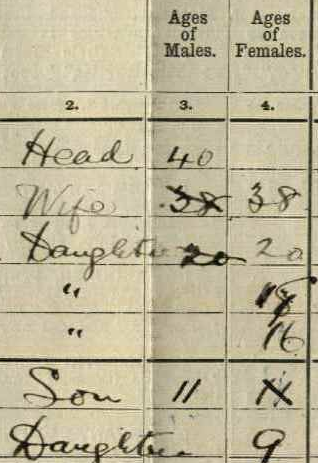
ages1


Here’s a picture of an actual 1911 census return, showing how confused the original data often was. That was written by my grandfather. Most of the ages are wrong, and I have the birth certificates to prove it. It’s very common for ages in census returns to be wrong – some of my relatives couldn’t write, let alone add up – but the birthdate calculator gives the precise limits on birthdate assuming that the data is correct.

There is confusion, at least in my mind, over whether the age entered on a census form should be that on the Sunday of the census, or that of the next day, the Monday. I suspect the rule may never precisely have been set down. The birthdate calculator makes the assumption that the age on the Sunday was stated. Maybe I should add an option to make it Sunday or Monday! Since the ages given for some of my relatives were out by 3 years, I’m not sure that Sunday or Monday matters too much.

The birthdate calculator makes allowance for the fact that, in the 1841 census, an age given which is both a multiple of 5 and is 15 or more, could have been rounded down. The calculator gives a wider range of possible birthdates for such ages.


Birthdate: time arithmetic is not reversible!

It’s 8 March 2008. Beth was born on 30 January 2008. How long ago was that, in months and days?

Well, it’s March 8 today, so if we go back one month and zero days, we get to February 8. So 7 February must have been one month and one day ago. So 1 February must have been one month and 7 days ago. 31 Jan was one month and 8 days ago. So 30 Jan was one month and 9 days ago. Voilà! Beth is 1 month and 9 days old!

Ah, but, hang on. It’s 30 January 2008 and Beth has just been born. How old will she be on 8 March 2008, in months and days?

It’s 30 January, so going forward 1 month gets us to 30 February, which is past the end of the month. 29 February (it’s a leap year) is 0 months and 30 days from 30 January, counting each day on the calendar. So the next day, 1 March, must be 1 month and 0 days. So 8 March must be 1 month and 7 days from 30 January. Beth will be 1 month and 7 days old on 8 March 2008.

Working backwards to calculate the time interval in months and days can give a different result to working forwards! There are two different answers to Beth’s age! Which is right?

When I first noticed this, I thought the answer was obvious. “On 8 March 2008, I’m asked how long it is since Beth was born. So, I work backwards until I reach her birthdate, and that’s the answer.” That would be a month and 9 days. So, that’s how I originally wrote the birthdate calculator, to work backwards.

However, it’s now clear to me that that choice isn’t at all obvious. It’s quite possible for people to work things out the other way, working forwards, and sometimes get a different answer. I need to modify the birthdate calculator to take account of that. I’ve not done that yet, so, for the moment, it only works backwards from the end date to the birthdate. The maximum difference in birthdate is 3 days. There’s only ever a difference if the age is specified in months and either weeks or days. It depends on the difference in the number of days in the month at the start and the end of the time interval. I’ll work on it!

Birthdates and the Month.

On October 4, I asked how old Toby was. “He’s six months, now.” What’s Toby’s birthdate?

Toby must have been born at the latest on April 4. If he had been born on April 5, he would have been only 5 months old on October 4. True, I would probably have been told, “He’s 5 months, 6 tomorrow.” But in official forms that ask age, people aren’t supposed to write, “Nearly 6 months.” And it’s official forms that are the common source material in family history.

Toby must have been born at the earliest on March 5. If he had been born on March 4, he’d be 7 months, not 6, on October 4.

So, the rule for computing birthdates when the age is given in months, is, take the date the question is asked, and move back to that same date, so many months ago. But what if the date doesn’t exist?

Someone born on March 31 is never, ever, exactly 1 month and 0 days old. She’s 0 months and 30 days on April 30. On May 1, she’s 1 month and 1 day old. This works just like birthdays for leap years.

So, if, on May 31, I ask, “How old is Andrew now?”, and the reply is, “One month and zero days”, then something’s wrong. That’s impossible. Andrew cannot have been born on April 31, because there hasn’t been an April 31, ever. If he was born on April 30, he is one month and one day old on May 31. If he was born on May 1, he is zero months and 30 days old on May 31.

To cope with the confusion of missing dates when we try to work backwards from the age-on-stated-date to birthdate, it helps to guess at a birthdate, then see if the age would have been that on the stated date. Move the guessed birthdate forwards or backwards until it just agrees with the given age. There isn’t any confusion working like this, because the guessed birthdate and the stated date when we asked the question are always real, existing calendar dates. We never have to deal with imaginary dates like April 31.

On 30 March 2008, I ask, “How Old is Amelia?”. “She’s One month and 30 days.” How do we work out the birthdate, when taking the “one month” off gets us to 30 Feb 2008, which never happened? Instead, work forward. Guess at a birthdate of 28 January and compute the age on 31 March. In this case, Amelia would have been 2 months and 0 days on 28 March, so 2 months and 2 days on 30 March. 2 months and x days is always longer than 1 month and y days, whatever the values of x and y. We don’t say, “She’s a month and 45 days old.” That would be silly.

The computed age on 30 March was too old, so we must have guessed at too early a birthdate. Move our guess forward, one day at a time, and compute the age on 30 March each time. We get a table something like this:

Amelia was 1 month and 30 days old on 2008/3/30. What’s her birthdate?
Guessed Birthdate Computed Age on 2008/3/30 Acceptable? Overshot?
Year Month Day Year Month Day
2008 1 28 0 2 2 No No
2008 1 29 0 2 1 No No
2008 1 30 0 2 0 No No
2008 1 31 0 1 30 Acceptable No
2008 2 1 0 1 29 No Overshot

We can see that the computed age on 2008/3/30 is too high, not “acceptable”. “Acceptable” is worked out by comparing the computed age on 2008/3/30 to the stated age on 2008/3/30. In this case, the stated age must be 0 years, 1 month, and 30 days, and all those have to match the computed age for it to be an acceptable guess. Creeping forward a day at a time, there isn’t an acceptable birthdate, until we get to a guessed birthdate of 2008/1/31. Is that the only acceptable date? Going on creeping forward, we find that a guessed birthdate of 2008/2/1 is not only not “acceptable”, it’s “overshot”, because the computed age is now too young and however much we creep forward, that computed age is only going to get younger, so we can stop creeping now.

If the stated age on date is not sensible – it’s one like “one month zero days on May 31” – there will not be an “acceptable” birthdate in this process before the “overshot” signal is found. That means the entered age on date is impossible.

Guessing at a birthdate like this, creeping forward, and computing the time interval to the date on which the age was specified, has the advantage of always working with real calendar dates – never imaginary ones like 31 April – and easily producing a reliable signal that the specified age-on-date is impossible. So, it’s a start. But there are still pitfalls, and that’s the subject for another post.
Birthdates and Leap Years.

On 29 Feb 2008, I asked Georgia how old she was. “I’m four, but will be five tomorrow!” Georgia was born on 1 March 2003. She doesn’t celebrate her 5th birthday until 1 March 2008, despite the fact that an extra day sneaks in just before then. On 29 Feb 2008, she’s 4 years and 365 days old. On 1 March 2008, she’s 5 years and 0 days old.

Anant was born on 29 February 2000. On 28 February 2007, ask him how old he is, and he’ll say, “Six!”. Ask him on 1 March 2007, and he’ll say, “Seven! And where’s my birthday present?” But, when was his birthday? Actually, sorry, but it wasn’t. People born on Feb 29 really do only have a birthday, the same date as they were born, every four years. They jump from being 6 years and 364 days old on Feb 28 to being 7 years and 1 day old on March 1, without ever being 7 years and 0 days old, that year. Anant might have a birthday party, he might have nice presents, but he doesn’t have a birthday.

The birthdate calculator understands leap years and (I hope!) gives the right answer for all leap-year-related birthdays.


Birthdates and time zones

Birthdays are celebrated midnight to midnight on the date written on someone’s birth certificate.

If the time zones change one year – double British Summer Time, or GMT – the celebration still happens from midnight to midnight, local time.

When Amanda was born, her birth was defined in local time, where she was born. A date was written down on her birth certificate using that local time. If Amanda flies around the world, she always celebrates her birthday in local time, midnight to midnight of the anniversary date. When speaking of ages and of birthdays, we always, by tradition, speak in terms of the local time where we are now, and the local time where we were when we were born, and we calculate differences in terms of the local time numbers on the clocks that were on the wall then.

This is just a convention. Changing the local time when local politics changes the daylight savings adjustment, or one moves between time zones, does not really change one’s age measured in seconds since birth. It’s quite a strongly enforced convention. “People under 18 may not be sold alcohol,” the law might say. “Show us your ID,” the shopkeeper says. Someone born at 23:59 on June 1 in Australia could be about 36 hours younger than someone born at 00:00 on June 1 in the UK, but both would be allowed to buy alcohol in the UK at exactly the same time – 00:00 on June 1, 18 years after they were born.

So, birthdates conventionally relate to what’s going to be written on the birth certificate, a local date, in local time, stating the date (but not time) of birth. Age is computed using that date, those same local numbers, even if you move time zone. That’s how laws are written and interpreted, at least in the UK, and I suspect, everywhere.

Because of this, the birthdate calulator is able (thank goodness!) to ignore timezones completely. Dates and times are always assumed to be stated in the local timezone. Even if someone is born in one timezone and moves to another.

It would be possible to write a law saying, “People are first allowed to buy alcohol 568021248 seconds after they were born”.  They couldn’t buy alcohol a bit earlier by changing time zones. But, we don’t write laws like that. We write laws that refer to the number written on the birth certificate, even if those numbers were in some other time zone.

Why isn’t birthdate arithmetic easy? Birth Years.

When someone says, “I’m 60 years old,” he means, “I have had my 60th birthday and have not yet had my 61st birthday.” Traditionally, someone born at any time from 00:00 (midnight) on june 1 to 23:59:59 (just before the next midnight) on June 1 has a birthday on June 1 every year. At least in the UK, by tradition, Independent of what time of day he was born, he will celebrate his birthday starting at 00:00 on each June 1, and will end his birthday at 23:59:59 on each June 1. 

Let’s set aside the effect of time zones on birthdays for another post. And let’s set aside the effect of changes of calendar, like the Julian-to-Gregorian change in 1752 in the UK, for another post too.

If the 60-year-old is speaking on a particular date , say yyyy/mm/dd, his 60th birthday could have been celebrated, at the latest, on yyyy/mm/dd. (So he’d be speaking on his 60th birthday). It could have been celebrated at the earliest on the day after (yyyy-1)/mm/dd. So his birthdate, the date written on his birth certificate, could have been anything from the day after (yyyy-61)/mm/dd up to (yyyy-60)/mm/dd.

“The day after” is just read off the calendar in the normal way. If (yyyy-1)/mm/dd is 1953/Dec/31, the day after is 1954/Jan/1. “The day after” 1953/Feb/28 was 1953/Mar/1. “the day after” 1952/Feb/28 was 1952/Feb/29, because 1952 was a leap year.

If you use the birthdate calculator to work out birthdate from someone’s stated age on a given day, and only fill in the ‘years’ field of the age, it’s understood that  you mean, they’ve celebrated that many birthdays, but you’re not sure when their birthday actually is. The birthdate calculator computes an earliest birthdate and a latest birthdate that could possibly make sense, according to the convention described above.